

Key Takeaways
A recycled radiator can be a practical repair, but only when the replacement matches the vehicle and has been properly checked. The safest purchase is based on identification, condition, total cost, and careful installation—not price alone.
- Match the radiator to the exact Haval model, year, engine, and transmission.
- Check the core, tanks, seams, fittings, and mounting points before buying.
- Ask whether the part was pressure-tested and what the warranty covers.
- Budget for coolant, hoses, clamps, labor, shipping, and possible related repairs.
- Bleed and test the cooling system thoroughly after installation.
Understanding recycled Haval radiators
Recycled Haval radiators are original vehicle parts removed from donor vehicles and offered for reuse after inspection. They may cost less than a new genuine part, but their history and remaining service life can vary. The right decision depends on evidence about fit and condition rather than the word “used” by itself.
What a recycled radiator is and how it differs from a new part
A recycled radiator has already operated in another vehicle, so it may show minor cosmetic wear even when it remains serviceable. A new radiator has no operating history, while an aftermarket unit may use different materials, construction, or fittings from the factory part. Ask what has actually been inspected, repaired, or replaced instead of assuming every recycled part has received the same treatment.
The cooling system also includes more than the radiator. A replacement will not correct a failed thermostat, blocked hose, weak water pump, or faulty fan, so the original overheating cause should be investigated before fitting another part.
Haval models commonly covered by recycled radiator suppliers
Availability changes with local vehicle dismantling activity, but suppliers may list radiators for models such as the Haval H6 and H9. Listings can distinguish petrol, hybrid, front-wheel-drive, and all-wheel-drive versions, and even a familiar model name does not prove that every radiator is interchangeable. Treat the listing as a starting point and verify the individual part.
For example, a used Haval H9 radiator listing identifies a 2017 petrol-engine part, while a separate H6 radiator support listing concerns a structural component rather than the radiator itself. Reading the part description closely prevents an expensive mix-up.
Why vehicle year, engine, and transmission configuration matter
Radiators can change during a model refresh or between production ranges. Engine output, hose routing, sensor locations, mounting tabs, and cooling capacity may differ even when the body shape looks similar. Automatic transmissions can also use an integrated or adjacent cooler, adding fittings that a manual-transmission radiator may not have.
Use the vehicle identification number, build month, engine code, gearbox type, and drive configuration when speaking with a supplier. Registration details alone may not identify every engineering change.
When a used radiator can be a sensible replacement
A recycled unit can make sense for an older vehicle, a short-term repair, or a model where a new genuine part is unusually expensive or difficult to source. It is most attractive when the supplier can provide clear photographs, a matching part number, a return period, and a written warranty.
The bargain disappears if the part arrives damaged, needs immediate repair, or causes a second installation because it leaks. A verified fit matters most when labor and coolant costs are part of the repair.
Choosing the correct radiator for your Haval
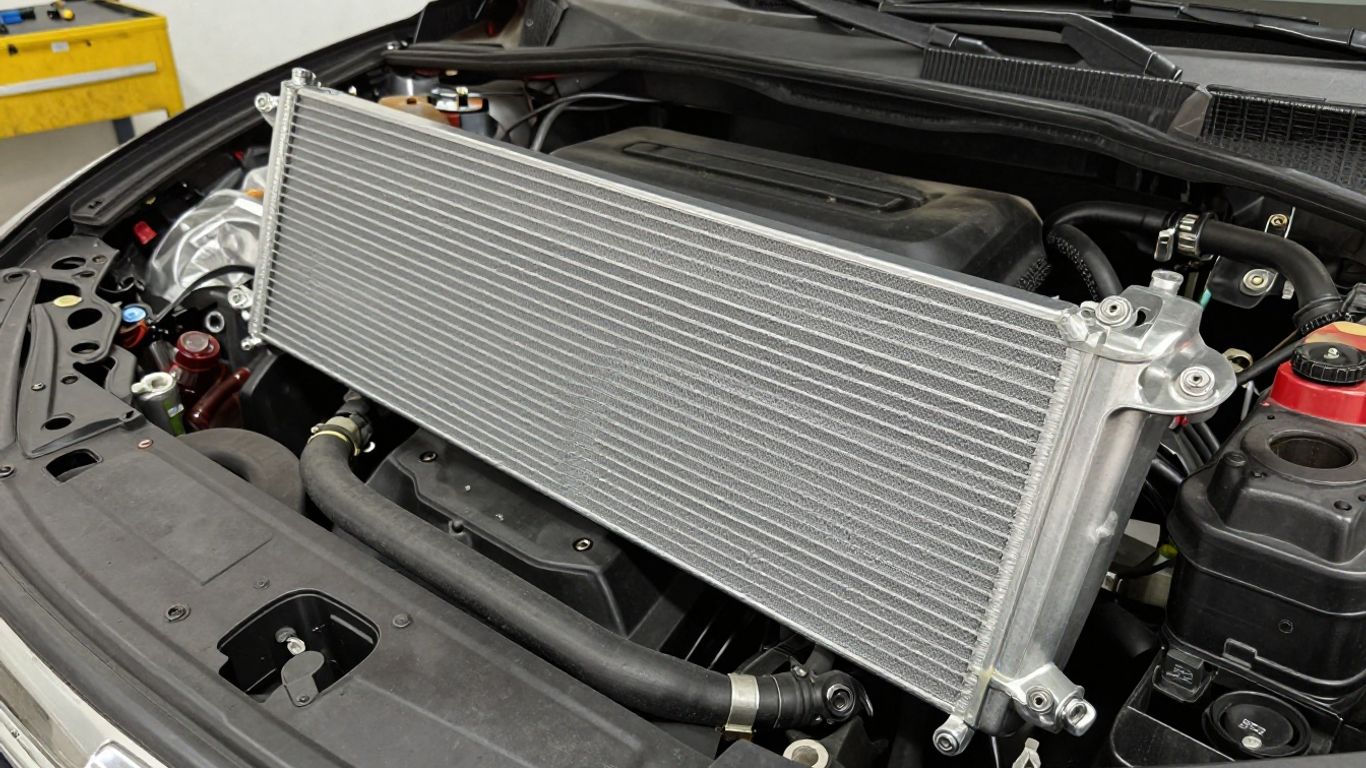
Correct identification is the first practical hurdle. Radiators that look close in an online photograph can differ in width, thickness, inlet position, outlet position, or transmission-cooler connections. Before ordering, compare the vehicle data with the seller’s information and request clarification in writing.
Matching the radiator to the exact Haval model and build year
Start with the model designation and build year, then add the engine and transmission details. A listing for a Haval H6 from one production period may not suit a later H6 even if both are described simply as “H6 radiator.” VIN confirmation is especially useful when catalog descriptions are brief or copied between listings.
Ask the seller to confirm compatibility, not merely to say that the part came from a Haval. Keep the confirmation with the order record in case the part does not fit.
Comparing OEM part numbers, dimensions, and mounting points
An OEM number is usually the strongest cross-check, though numbers can be superseded or vary by market. Compare it with the dimensions and photographs, including the upper and lower mounts, side brackets, drain location, filler neck, and hose outlets. A similar-looking core is not enough if the mounting points place stress on the hoses or fan shroud.
When no part number is available, ask for measured dimensions rather than relying on an image. The seller should be able to identify what is known and what remains uncertain.
Checking compatibility with automatic transmission cooling systems
An automatic-transmission radiator may include separate cooler ports or an internal cooler. Confirm the number, thread style, and position of those connections, along with whether the necessary fittings are supplied. Never leave a transmission-cooler line improvised or incorrectly capped; it can create leaks and affect transmission operation.
The vehicle’s service information should determine the correct fluid and connection procedure. If the radiator specification is unclear, a qualified technician should verify it before installation.
Confirming whether hoses, fans, shrouds, and brackets are included
Radiator listings often show neighboring components without including them in the sale. Confirm whether the price covers the radiator alone or also includes the fan assembly, shroud, brackets, rubber mounts, sensors, caps, and cooler fittings. A complete-looking photograph is not an inventory list.
A useful order message should ask four simple questions before payment:
- What exact vehicle supplied the radiator?
- What part number and measurements can you confirm?
- Which fittings, mounts, and accessories are included?
- What happens if the part does not fit or leaks?
The answers give you a clearer basis for comparison than a low headline price. They also create a record of what the seller promised.
Assessing the condition of a recycled radiator
Condition checks should focus on function as well as appearance. Aluminum cores can be damaged by impact, careless removal, or corrosion, while plastic tanks may develop cracks around hose necks and seams. If photographs are the only inspection available, request close views of every connection and corner.
Inspecting the core, fins, tanks, and seams for damage
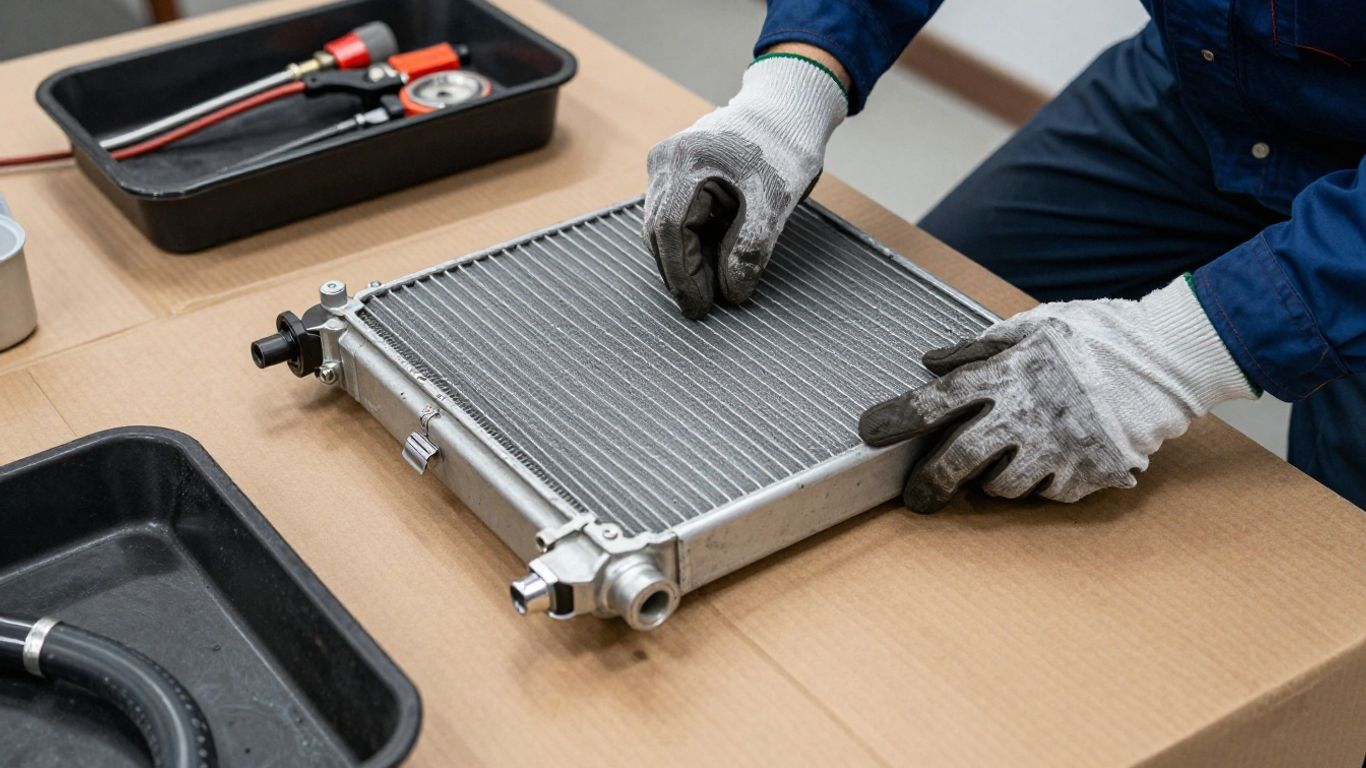
Look for crushed fins, bent channels, punctures, split tanks, and distorted mounting tabs. A few flattened fins may be cosmetic, but broad damage can reduce airflow. Check the hose necks for ovaling or cracks and inspect the seam between the tank and core for staining or separation.
The radiator should sit flat and square. Any twist, deep dent, or broken mount deserves an explanation before the part is purchased.
Identifying signs of leaks, corrosion, blockage, or previous repairs
White, green, pink, or rusty residue can indicate dried coolant, depending on the coolant used. Oil contamination inside the radiator is also a warning sign, particularly if the vehicle had a head-gasket or transmission problem. Solder, epoxy, fresh paint, or unusually clean patches may point to an earlier repair.
A repair is not automatically disqualifying, but its location and test result matter. A seller who cannot explain a repaired seam or blocked section should not be your first choice.
Asking how the radiator was removed, stored, and tested
Removal history can reveal whether fittings were cut, mounts were forced, or the radiator was allowed to drain fully. Storage matters too: an exposed part can collect dirt, moisture, and debris in the fins and ports. Ask whether openings were capped and whether the unit was kept dry.
A supplier’s wider inventory may help establish whether it understands the vehicle, but quantity alone is not proof of quality. For instance, a listing of used H6 components can show model-specific dismantling experience without confirming the condition of any particular radiator.
Understanding pressure-testing and supplier inspection standards
Pressure-testing is more useful than a visual promise that the radiator “looked good.” Ask what pressure was used, how long the unit was tested, and whether the test covered the radiator and cooler passages. Also ask when the test occurred, since damage can happen during storage or shipping.
The result should be tied to the exact stock number or part being sold. If a supplier uses a general inspection process, request its written terms and find out how defects discovered after delivery are handled.
Comparing costs, warranties, and supplier reliability
The advertised price is only one part of the repair. Shipping, deposits, coolant, replacement seals, labor, and disposal can change the final figure. A reliable supplier may cost a little more while reducing the risk of paying for a second removal and installation.
Calculating the total cost beyond the advertised radiator price
Write down the expected cost before comparing options. Include delivery, local pickup, return freight, taxes, core charges, installation time, and any parts that should be replaced while the system is open. Also allow for a coolant flush and proper refill rather than treating those materials as an afterthought.
A simple comparison table can expose the cheaper-looking option that carries more uncertainty:
| Cost or risk | Recycled part | Aftermarket part | New genuine part |
|---|---|---|---|
| Purchase price | Usually lower | Often moderate | Usually higher |
| Known operating history | Variable | New, design varies | New, factory-specified |
| Fitment confidence | Depends on identification | Depends on catalog accuracy | Usually strongest |
| Return and warranty terms | Supplier-specific | Brand-specific | Seller or manufacturer-specific |
The table is a planning tool, not a guarantee about any individual listing. Confirm actual prices and terms before ordering, then compare the total repair cost rather than the radiator line alone.
Comparing recycled, aftermarket, and new genuine alternatives
A recycled radiator may be the sensible value choice when its identity and test record are clear. An aftermarket part offers a new core but can vary in construction and fit, while a new genuine radiator generally offers the clearest factory specification at a higher price. The best option depends on vehicle age, use, urgency, and the consequences of another failure.
Do not assume that new automatically means correct. The catalog number, cooler arrangement, mounts, and hose locations still need to match the vehicle.
Reviewing warranty coverage, returns, and fitment guarantees
Read the warranty for exclusions, claim deadlines, labor coverage, and requirements about coolant, installation, or overheating. Some warranties cover the part but not diagnosis, removal, shipping, or consequential damage. A return period may also be different from a warranty period.
Ask whether the seller will accept a return if the part is incompatible, and whether it must be unused or professionally installed. Keep photographs of the part and packaging when it arrives.
Evaluating wreckers, recyclers, and online parts sellers
A trustworthy seller communicates clearly, identifies the donor vehicle, documents condition, and explains its process. Online marketplaces can offer useful choice, but the buyer must inspect the listing details and seller terms carefully. Local recyclers may make inspection and collection easier, while established parts networks can offer broader stock.
A seller’s responsiveness before payment is a useful, though imperfect, signal. If basic questions about part numbers, testing, or returns receive vague answers, consider that uncertainty part of the price.
Preparing for installation
Preparation prevents a replacement radiator from becoming a repeat repair. First establish why the original failed: a collision, corrosion, blocked airflow, failed fan, or overheating event can affect other components. Work only on a fully cool engine and follow the vehicle’s service instructions for coolant handling.
Flushing the cooling system before fitting the replacement
If the old coolant is dirty, contaminated, or mixed with an unknown type, drain and flush the system using the procedure specified for the vehicle. Remove loose debris without forcing contaminated fluid into sensitive components. Dispose of coolant responsibly because it is hazardous to people and animals.
A flush is not always appropriate in the same way for every system, so avoid aggressive chemicals unless the service information or a qualified technician supports their use. The replacement radiator should not be installed into a system that still contains obvious contamination.
Replacing worn hoses, clamps, seals, and the radiator cap
Radiator hoses can harden, soften, swell, or crack near the clamps. Replace questionable hoses and use suitable clamps, new seals, and a radiator cap with the specified pressure rating. Reusing a distorted clamp or old seal can create a leak that looks like a faulty radiator.
Inspect the rubber mounts as well. A missing or damaged mount can transmit vibration into the radiator and put strain on its tanks and connections.
Checking the cooling fan, thermostat, water pump, and coolant condition
The fan should operate as required by the vehicle’s control system, and the thermostat should open at the proper temperature. Look for water-pump leakage, bearing noise, belt problems, and evidence that the engine has already suffered severe overheating. A new radiator cannot compensate for inadequate circulation or airflow.
If the cause of the original failure is uncertain, diagnosis before installation is cheaper than repeating the job. The cooling system should be considered as one connected system.
Following the correct coolant specification for the Haval model
Use the coolant type and dilution specified for the particular vehicle, rather than choosing by color alone. The owner’s manual or service information is the primary reference; a general coolant selection guide can help explain why specification and water quality matter. Do not mix incompatible formulations without confirming that they are suitable.
Use clean, appropriate water for dilution when the coolant is supplied as concentrate. Record what was added so future servicing does not begin with an unknown mixture.
Installing and testing a recycled Haval radiator safely
Installation should be treated as a complete cooling-system service, not simply a component swap. Protect the condenser and other nearby parts during removal, keep dirt out of open lines, and never open a pressurized system while hot. If access is difficult or the vehicle requires a special bleeding procedure, professional installation is the safer choice.
Removing the damaged radiator without contaminating the system
Let the engine cool completely, disconnect the battery if the service instructions require it, and drain the coolant into a suitable container. Remove the fan shroud, hoses, electrical connectors, and cooler lines carefully, labeling connections where necessary. Cap open lines and keep fasteners organized so dirt and fluid do not enter the system.
Do not pry against fragile tanks or bend the condenser to gain clearance. Photographing the original routing can make reassembly easier, especially around shrouds and clips.
Installing the replacement and reconnecting all cooling lines
Compare the old and replacement radiators on the bench before lowering the new unit into place. Transfer only the components that are confirmed to belong with the replacement, then seat the rubber mounts and tighten brackets without forcing them. Reconnect each hose, clamp, sensor, fan connector, and transmission-cooler line according to the service instructions.
Check that hoses do not rub against the fan, belt, bodywork, or sharp brackets. A connection that feels nearly right may still be wrong if its angle or locking feature does not match.
Bleeding trapped air from the cooling system
Refill with the specified coolant mixture and use the vehicle’s prescribed bleed points or filling procedure. Air pockets can prevent proper circulation and create local hot spots, so do not assume that a full expansion tank means the system is full. A radiator bleeding guide can provide general background, but the Haval-specific service procedure takes priority.
After the initial fill, allow the system to circulate as directed, watching the level and temperature. Do not remove a cap from a hot, pressurized system; pause and let it cool before checking anything.
Checking operating temperature, leaks, and coolant levels after installation
Inspect every seam, hose joint, drain, cooler connection, and cap area while the engine reaches normal operating temperature. Confirm that the fan cycles correctly and that the temperature remains stable during a short, careful road test. Recheck the coolant level after the vehicle cools and look for fresh residue or a falling level.
Do not continue driving if the temperature rises abnormally, the warning light appears, coolant leaks, or the cabin heater changes unexpectedly. Stop safely, allow the engine to cool, and have the system diagnosed before further use.
Conclusion
Recycled Haval radiators can offer a reasonable replacement when the part is correctly identified, honestly described, tested, and supported by sensible return terms. Compare the complete repair cost, prepare the surrounding cooling system, and test the installation patiently; those steps matter more than simply finding the lowest listing.
Frequently Asked Questions
Are recycled Haval radiators reliable?
They can be reliable when the radiator matches the vehicle and has been inspected and pressure-tested, but condition varies between parts. Ask for evidence rather than assuming every used unit has the same service life.
How do I know which radiator fits my Haval?
Use the VIN, model, build year, engine, transmission, drive configuration, OEM part number, dimensions, and mounting points. Confirm cooler connections as well, particularly on automatic-transmission vehicles.
Should I replace hoses when installing a used radiator?
Replace hoses, clamps, seals, or mounts that are brittle, swollen, damaged, or distorted. Access is often easiest while the radiator is already removed.
Can a used radiator be pressure-tested?
Yes. Ask the supplier what pressure and test duration were used, which passages were checked, and whether the result applies to the exact part being sold.
What coolant should I use after replacing a radiator?
Use the specification and dilution stated for the vehicle. Color alone is not a dependable way to identify compatibility, and unknown mixtures should be avoided.
Why does the engine still overheat after radiator replacement?
Possible causes include trapped air, a failed fan, thermostat, water pump, hose, cap, blocked passage, or an unresolved engine problem. Stop driving if the temperature rises and have the system diagnosed.
How long should I monitor the replacement radiator?
Check for leaks and coolant-level changes after the first heat cycle and again after a short drive. Continue watching the temperature gauge and inspect the system only when the engine is cool.