

Key Takeaways
A used turbocharger can be a practical repair part, but only when fitment, condition, history, and installation requirements are checked together.
- Match the turbocharger to the exact engine, transmission, market, and vehicle year.
- Treat shaft play, wheel damage, oil contamination, and actuator faults as warning signs.
- Compare the complete fitted cost rather than focusing only on the advertised price.
- Ask for clear identification, inspection evidence, and written return terms.
- Correctly diagnose the original failure before installing any replacement turbocharger.
Understand Haval turbocharger compatibility
Buying second hand Haval turbochargers starts with identification, not price. A turbocharger that looks similar may have different oil connections, actuator controls, compressor housings, or calibration requirements. The safest approach is to build a precise match from the vehicle and the part itself.
Haval vehicles have appeared with different powertrains and equipment across markets, so a model name alone is not enough. Use the vehicle identification number, engine code, and original turbocharger markings together before committing to a purchase.
Haval models and engine variants
Start by recording the model, build year, engine size, engine code, transmission, and drivetrain. Even within one model line, a change in engine generation can alter the turbocharger, sensors, pipework, and mounting arrangement. An Haval H6 overview can help with general model background, but it should not replace vehicle-specific fitment verification.
A used-car listing may also provide useful clues about the donor vehicle. For example, a 2020 Haval H6 listing describes a 1.5L turbocharged engine, but that information alone does not prove that every 1.5L H6 uses the same turbocharger. Confirm the exact engine code and part number instead of relying on displacement.
Turbocharger part numbers and revisions
Read every marking on the old unit before removal if possible, then photograph the identification plate and housing. Manufacturer numbers, supplier numbers, revision letters, and actuator codes can all matter. A later revision may be compatible, but that should be confirmed through a parts catalogue, dealer, or experienced turbocharger specialist.
Do not assume that a matching-looking compressor housing means the internal assembly is identical. Small differences in wheel design or calibration can affect boost control, oil routing, and the way the unit interfaces with the engine management system.
Petrol, diesel, and hybrid system differences
Petrol and diesel engines place different demands on turbocharger design, exhaust temperature management, and boost control. A hybrid powertrain may also combine an internal-combustion engine with additional control systems that make a superficially similar turbocharger unsuitable. The engine type must therefore be part of the match, not an afterthought.
When a listing uses broad language such as “fits Haval,” ask which fuel type and engine family the seller has actually verified. If the answer is vague, treat the unit as unconfirmed rather than making the assumption yourself.
Why vehicle year and market matter
A vehicle assembled for one market may use different emissions equipment, software, sensors, or turbocharger revisions from a similar vehicle sold elsewhere. Production changes can occur during a model run, too. This is why registration details and a general online Haval cars for sale market view are useful context but not final proof of compatibility.
The donor vehicle’s market can also affect connector shapes and ancillary components. Ask where the donor was originally sold and whether the turbocharger was removed from a running vehicle or a damaged one.
How to confirm fitment before buying
Before paying, send the seller the VIN, engine code, original part number, and clear photographs of the mounting faces and actuator. Request confirmation in writing that the offered unit matches those details. A video review of a 2022 Haval Jolion turbo may help you understand the model, but performance discussion is not a substitute for parts identification.
Make the comparison physical where possible: flange position, oil feed and drain locations, exhaust outlet, compressor inlet, and actuator arrangement should all correspond. Fitment evidence matters more than appearance when a part operates at high speed and temperature.
Assess the condition of a used turbocharger
Condition is difficult to establish from a single photograph. A clean housing may conceal bearing wear, a bent shaft, heat damage, or an actuator that no longer responds correctly. A careful inspection should cover the rotating assembly, housings, oil passages, and control mechanism.
The safest used units have a traceable donor story and inspection evidence, rather than merely a low asking price. This used turbocharger safety guide offers a useful general reminder that testing and verification are more meaningful than age alone.
Signs of shaft and bearing wear
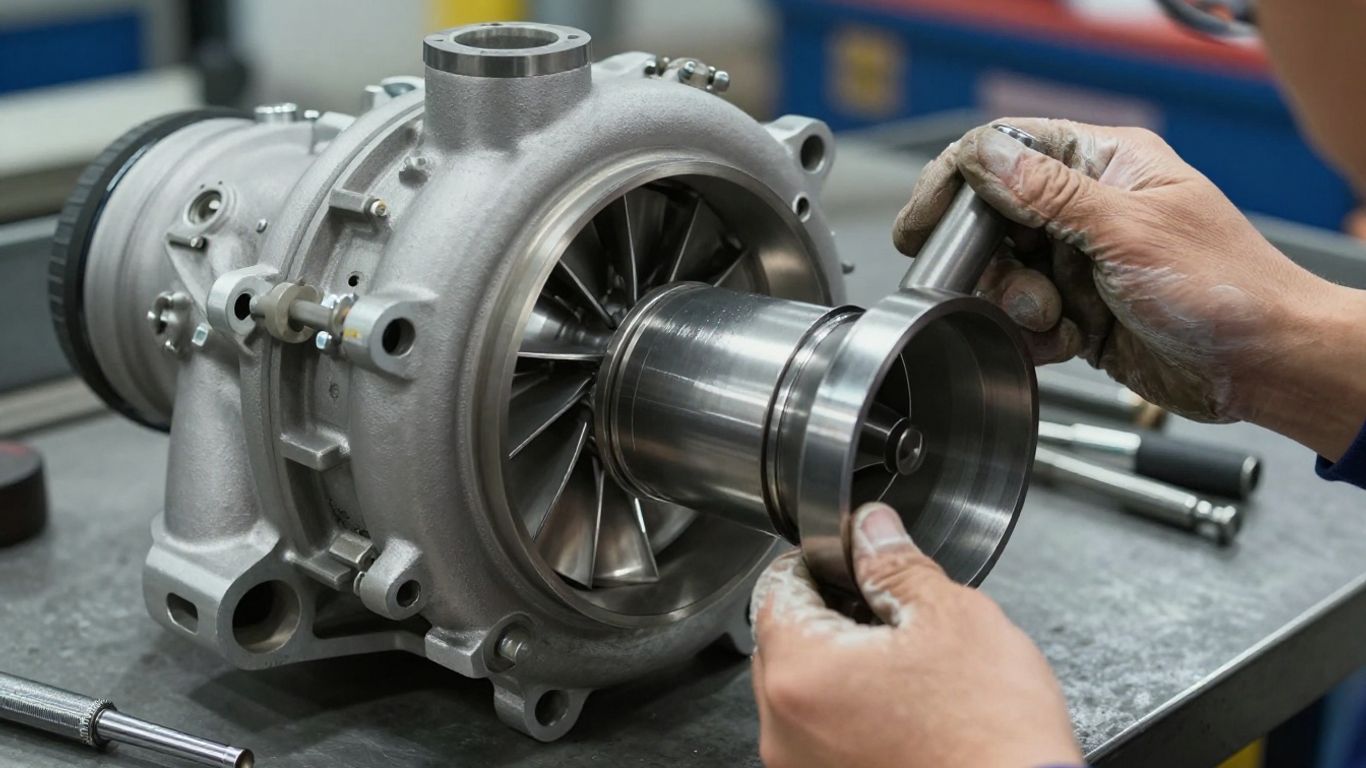
With the unit removed and clean, gently check shaft movement according to the manufacturer’s inspection limits. Some slight movement can be normal before oil pressure supports the shaft, but contact between a wheel and housing, rough rotation, or obvious radial and axial looseness is a serious concern.
Do not spin the shaft aggressively or try to diagnose the whole turbo by feel alone. A specialist can measure clearances and identify wear that is not obvious during a casual inspection.
Inspecting the compressor and turbine wheels
Look for chipped, bent, cracked, or heavily eroded blades on both wheels. The compressor wheel should not show signs of contact with its housing, while the turbine side deserves particular attention for heat distortion, missing material, or foreign-object damage.
Inspect the housings for impact marks and distorted edges as well. Damage to one wheel may indicate that debris entered through the intake or exhaust system, which could mean the replacement needs more investigation than a simple visual clean-up.
Checking for oil leaks and carbon buildup
Oil residue inside a turbocharger is not automatically proof of failure because the lubrication system naturally carries oil through the centre housing. However, heavy pooling, sludge, blocked passages, or evidence of oil escaping past the seals deserves explanation. Carbon deposits on the turbine side can also point to excessive heat or poor operating conditions.
Ask whether the turbo was drained, cleaned, and inspected before sale. A seller who cannot explain the condition of the oil passages may be offering an untested core rather than a ready-to-install component.
Evaluating the wastegate and actuator
The wastegate or variable control mechanism must move correctly and without binding. Depending on the turbocharger, the actuator may be pneumatic, electronic, or mechanically linked, so testing needs to follow the correct method rather than forcing the lever by hand.
Check for a damaged rod, loose linkage, corrosion, or an actuator housing that has been struck. An otherwise healthy rotating assembly can still produce an expensive problem if the boost-control mechanism is incompatible or faulty.
Understanding mileage and service history
Mileage is useful only when it is supported by a credible donor history. A low-mileage donor involved in a collision may have a sound turbocharger, while a higher-mileage unit with consistent oil changes and documented testing may be a better proposition than an unknown “low-mileage” part.
Ask how the donor vehicle failed, whether the engine ran before dismantling, and how the turbocharger was stored. Long-term exposure to moisture, open oil ports, or loose packaging can create problems that were not present when the part was removed.
Compare second hand Haval turbocharger prices
The advertised price is only the first number in the decision. A low-cost turbocharger may need cleaning, actuator testing, gaskets, lines, or professional balancing before it can be trusted. Conversely, a slightly more expensive unit with documented testing and a useful warranty may reduce the total repair risk.
Compare like with like: same part number, same actuator type, similar condition, equivalent inspection, and similar return protection. That gives the price comparison some meaning.
Factors that influence used turbocharger value
Value depends on compatibility, condition, scarcity, donor mileage, testing, included hardware, and the seller’s return terms. A complete unit with an intact actuator and documented inspection generally deserves a different assessment from a bare turbocharger sold for parts.
Location and freight also affect the practical price. A unit that travels a long distance without protective packaging may arrive damaged, and a return shipment can be costly if the seller’s policy is unclear.
Comparing used, remanufactured, and new units
A used unit retains its original wear history, while a remanufactured unit should have defined reconditioning work and testing. A new turbocharger usually offers the clearest baseline, but it may not be economically sensible for every vehicle or repair budget. The choice should reflect the car’s value, expected ownership period, and confidence in the diagnosis.
Ask exactly what “remanufactured” includes. Replacing seals alone is not equivalent to measuring the shaft, checking the wheels, testing the actuator, and balancing the rotating assembly.
Estimating installation and related repair costs
Installation may involve more than unbolting one component. Budget for labour, gaskets, oil and coolant, cleaning, fasteners, intake hoses, oil lines, intercooler inspection, and diagnostic checks. If the old turbo failed internally, the engine may also need further examination before the replacement is run.
The following cost categories make quotes easier to compare because they separate the part from the work around it:
| Cost category | What to confirm | Why it matters |
|---|---|---|
| Turbocharger | Part number, actuator, inspection status | Establishes whether the core part is suitable |
| Installation | Labour hours and workshop method | Reveals the real fitted price |
| Ancillary parts | Gaskets, seals, lines, filters, hardware | Prevents reuse of contaminated or damaged items |
| Follow-up checks | Oil pressure, boost control, fault-code scan | Helps confirm the repair was successful |
After adding these items, a supposedly cheap unit may no longer be the cheapest option. The comparison should be made against a complete repair, not against another bare listing.
Recognizing unusually cheap listings
An unusually low price may indicate a damaged core, missing actuator, seized mechanism, unknown mileage, or a part that has not been tested. It can also reflect a private seller who simply wants quick disposal, but that possibility does not remove the need for evidence.
Be wary of stock photographs, vague compatibility statements, and descriptions that avoid saying whether the shaft has been checked. A low price is useful only when the risks behind it are understood and accepted.
Calculating total ownership value
Consider how long you expect to keep the vehicle and how difficult a second repair would be. A used turbocharger with a short return window may be reasonable for a temporary repair, but less attractive if removing and refitting it would require substantial labour.
Include downtime, freight, diagnostic fees, and the possibility of replacing related components. The best value is often the option that gives a credible path to a lasting repair at a tolerable total cost.
Verify the seller and turbocharger history
Seller quality matters because a turbocharger’s internal condition is hard to judge remotely. Clear answers, consistent photographs, and written terms do not guarantee a good part, but evasive answers increase the risk considerably.
Treat the transaction as a technical purchase. You are not only buying metal housings; you are buying confidence that the part was identified, stored, and described honestly.
Questions to ask the seller
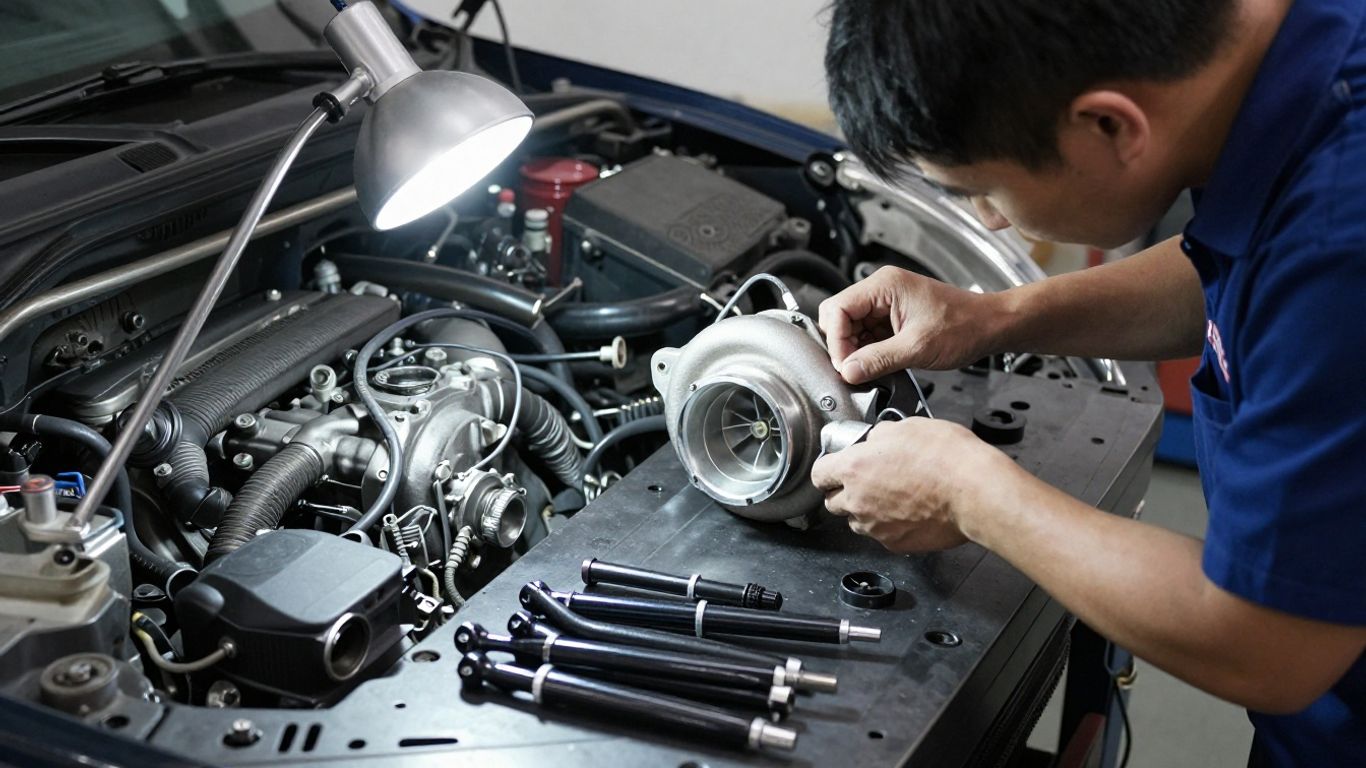
Ask for the donor model, engine code, VIN if available, mileage, failure circumstances, part number, actuator type, and inspection process. Also ask whether the unit was removed from a running vehicle, how it was packaged, and what components are included.
A useful seller should be able to distinguish between a tested replacement and an untested dismantler’s part. If every answer is “it should fit,” pause before sending payment.
Checking testing and inspection records
Request a written inspection report or test result that identifies what was checked. Depending on the unit, this may include shaft clearances, wheel condition, actuator operation, oil passage condition, and balancing or flow testing.
Records should relate to the actual turbocharger being sold, not a generic document copied across multiple listings. If the seller cannot provide evidence, price the unit as untested and consider whether the risk is acceptable.
Reviewing photos, markings, and serial numbers
Photographs should show the identification plate, compressor inlet, turbine outlet, actuator, mounting faces, and oil ports. Compare those images with your original part and ask for fresh photographs if the listing uses only catalogue images.
Serial numbers and markings should be legible and consistent across the housing and paperwork. Missing, ground-off, or freshly painted identification areas are reasons to seek further explanation.
Confirming return and warranty policies
Read the return policy before buying, especially for a part that may not reveal its fault until installation. Confirm the length of the return period, who pays freight, whether the unit must remain uninstalled, and whether labour costs are excluded.
A warranty may also require proof of correct installation, fresh oil, new filters, cleaned intercooler components, or diagnosis of the original failure. Knowing those conditions in advance prevents an unpleasant dispute later.
Avoiding damaged or misrepresented parts
Walk away when the description contradicts the photographs, the seller refuses basic identification questions, or the unit appears to have impact damage near a wheel or actuator. Payment protections are helpful, but they do not turn an unclear part into a safe one.
Keep the listing, messages, photographs, and invoice. Even a straightforward purchase benefits from a record of what was promised and which part number was supplied.
For general online buying, keep personal information limited and review the seller’s Privacy Policy where one is available. That is separate from technical verification, but it is a sensible part of dealing with unfamiliar websites.
Prepare for installation and related repairs
A replacement turbocharger cannot correct the cause that destroyed the original one. Oil starvation, blocked feed lines, foreign-object damage, overspeed, exhaust restriction, and engine problems can damage a second unit quickly if they are left unresolved.
Installation should therefore begin with diagnosis and cleaning, not with opening the box and fitting the part. The workshop should understand both the turbocharger and the engine system around it.
Diagnosing the original turbocharger failure
Find out why the first turbocharger failed. Examine the oil, intake tract, air filter, intercooler, exhaust side, and engine for signs of contamination or mechanical trouble. If the shaft broke or a wheel disintegrated, look for fragments downstream and upstream before starting the replacement.
Fault codes can guide the investigation but do not identify every mechanical cause. A boost-control code, for example, may result from a leak, actuator problem, sensor issue, restriction, or the turbocharger itself.
Inspecting oil lines, filters, and intercooler components
Oil feed and drain lines should be checked for blockage, kinks, sludge, and carbon restriction. Replace the oil and filter, and clean the intercooler and intake plumbing when contamination from the failed unit may be present.
The air filter and intake hose should seal properly, while the exhaust system should be checked for restrictions. Reusing contaminated oil or a restricted feed line can undermine an otherwise sound replacement.
Replacing gaskets, seals, and mounting hardware
Use the correct gaskets, seals, clamps, and mounting hardware specified for the repair. Old sealing surfaces can distort or leak after removal, and over-tightened or stretched fasteners may not clamp the replacement correctly.
Do not apply sealant where the turbocharger manufacturer does not permit it, particularly near oil passages. The installer should confirm torque settings and ensure that pipes are clean before connection.
Following correct priming and installation procedures
Prime the turbocharger with clean engine oil through the appropriate inlet before initial operation, then follow the vehicle and turbocharger manufacturer’s starting procedure. Avoid immediately raising engine speed; the unit needs oil circulation before it is asked to work under load.
After starting, check for oil, coolant, exhaust, and intake leaks. A controlled inspection and diagnostic scan are preferable to repeated hard acceleration while the repair is still unverified.
A practical video can illustrate inspection and priming concepts, but it should support—not replace—the workshop manual and the instructions supplied with the actual turbocharger.
When professional installation is worthwhile
Professional installation is especially sensible when the failure involved broken wheels, heavy oil contamination, repeated boost faults, or an electronic actuator. The cost of skilled diagnosis can be lower than removing a replacement unit a second time.
Choose a workshop that will document the cause, replace contaminated consumables, and verify operation after installation. A clear written estimate should distinguish diagnostic work from fitting labour.
Make a confident purchase decision
The right purchase is not necessarily the newest or cheapest turbocharger. It is the part that fits the vehicle, has a believable condition report, comes from a seller with workable terms, and can be installed after the original failure has been addressed.
Take a short pause before paying. Matching the evidence to your repair objective is more reliable than being persuaded by a polished photograph or a large discount.
Matching the turbocharger to your repair goals
Decide whether you need a temporary low-cost repair, a dependable used replacement, or the strongest available warranty position. That decision affects how much history, testing, and return protection you should demand.
If the vehicle is otherwise sound and you plan to keep it, spending more on verification and installation may be sensible. If the vehicle has several unresolved faults, a lower-risk repair strategy may require a broader assessment first.
When a second hand unit is a sensible choice
A second hand turbocharger can make sense when the part number is confirmed, the donor history is credible, the rotating assembly is within specification, and the seller offers reasonable return protection. It is also more attractive when the surrounding engine and lubrication systems have been checked.
The decision becomes weaker when the part is untested, heavily corroded, missing its actuator, or sold without identification. In those cases, the apparent saving may simply transfer the cost into later labour.
Situations that call for a remanufactured or new turbo
Choose a remanufactured or new unit when the vehicle is valuable, downtime is costly, the used market is uncertain, or the failure could have contaminated the engine system. A defined rebuild process and warranty can justify the higher initial price.
A new unit may also be appropriate where no verified used match is available or where the turbocharger revision is especially sensitive to calibration. The choice should follow diagnosis and fitment evidence, not fear or habit.
Final pre-purchase checklist
Before completing the transaction, make sure the practical details are recorded rather than left to memory. A compact final check can prevent an expensive mismatch:
- Confirm the VIN, engine code, market, and vehicle year.
- Match the turbocharger identification plate and actuator arrangement.
- Obtain inspection details, donor history, and current photographs.
- Calculate freight, installation, consumables, and possible diagnostic costs.
Once those points are documented, compare the complete offers and decide whether the remaining uncertainty is acceptable. If the seller will not provide the information, declining the purchase is a valid outcome.
Maintenance practices that extend turbocharger life
Use the correct oil and change it at the recommended intervals, keep the air filter and intake system sealed, and respond quickly to boost leaks or unusual smoke. Allow the engine to reach normal operating temperature before demanding heavy load, and investigate new whines, oil consumption, or loss of power promptly.
Good maintenance cannot repair a defective turbocharger, but it reduces preventable stress on a sound one. Keep service records, including oil specifications and any work carried out on the lubrication or intake systems.
Conclusion
Second hand Haval turbochargers can offer a sensible route to repair when the exact fitment is proven and the unit’s condition, history, seller terms, and installation requirements are treated as one decision. Compare total ownership cost, not just the listing price, and do not let an uncertain part undermine the rest of the engine repair.
Frequently Asked Questions
Are second hand Haval turbochargers safe to buy?
They can be safe when the part is correctly identified, professionally inspected, and supported by a credible return or warranty policy. An untested turbocharger should be treated as a risk rather than a ready-to-fit replacement.
How do I identify the correct turbocharger?
Use the vehicle identification number, engine code, build year, market, original turbocharger part number, actuator type, and physical mounting details. Confirm the match with a reliable parts source before purchase.
Is shaft play always a sign that a turbocharger is bad?
Not necessarily. Some movement can occur before the turbocharger is supported by oil pressure, but contact with the housing, rough rotation, or excessive axial or radial movement requires specialist measurement.
What should I ask a used turbocharger seller?
Ask about the donor vehicle, mileage, failure circumstances, part number, inspection tests, actuator operation, storage, included hardware, and return terms. Request evidence that relates to the exact unit being sold.
Should I replace the oil lines when fitting a used turbocharger?
Inspect them carefully for blockage, sludge, kinks, or heat damage, and replace them when their condition is uncertain or the original failure involved oil starvation. Fresh oil and a new filter are also commonly part of a proper repair.
Can a used turbocharger be installed without diagnosing the original failure?
It should not be. The same blocked oil feed, intake contamination, exhaust restriction, or engine fault that damaged the original may quickly damage the replacement.
Is a remanufactured turbocharger better than a used one?
It may provide more predictable condition when the rebuilding process, testing, and warranty are clearly documented. The best option depends on verified fitment, repair goals, vehicle value, and the complete fitted cost.